


Impression: After Drinking Rare Sake, Kin-suzume(金雀)
February 8th, at my friend’s place in Yamaguchi Prefecture.
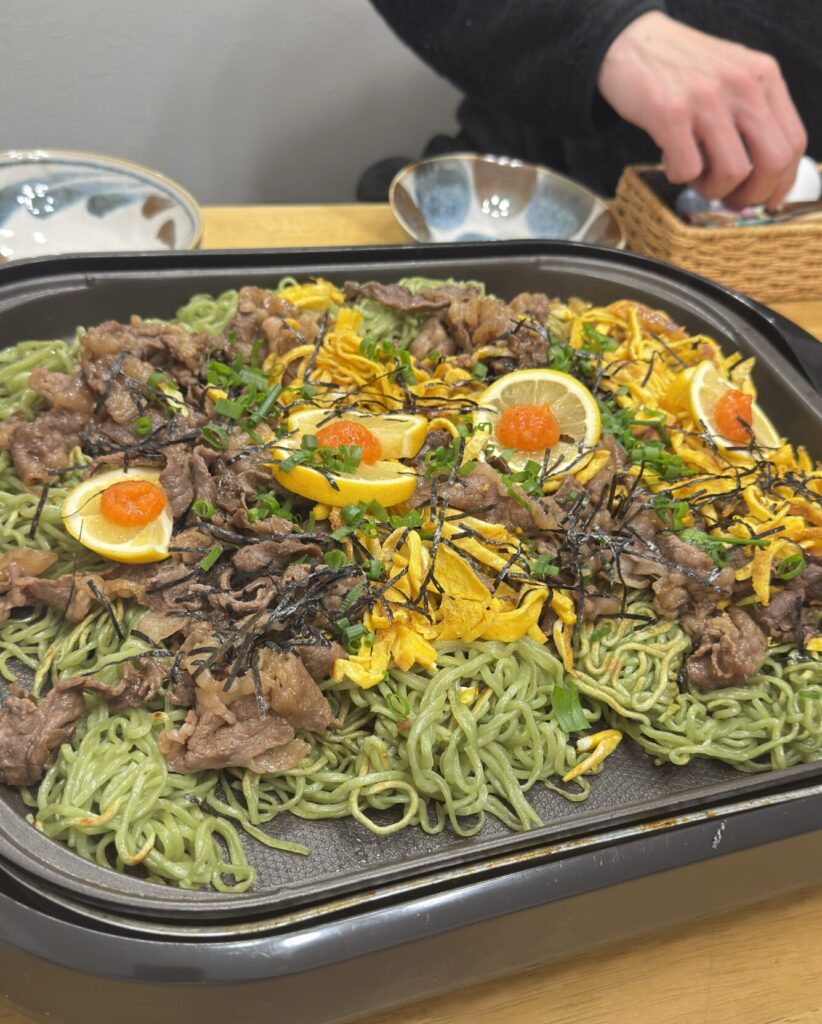
Three months have already gone by. Since I visited my friend in Yamaguchi.
Every now and then I find myself thinking it’s about time I headed back — but packing up a baby and spending the night in another prefecture is hardly a casual stroll around the neighborhood, and between constantly making videos and dreaming up posts for the blog, not to mention (Minecraft demands attention too), I still genuinely want to go back to Yamaguchi.
And of course, as I’ve been saying all along, the reason I’d go isn’t exactly to see my friend.
It’s that I want to visit the Kin-Suzume brewery.
When I went in February, there was a heavy snowfall warning, and the brewery sits on the other side of a mountain — so getting there was simply out of the question. And even if you make the trip, there’s no guarantee you’ll actually be able to buy anything.
But now that the weather has finally softened, I find myself thinking — maybe it’d be easy to get there. If I stopped by Horie Sakaba, would I be able to walk out with a whole bottle..? The reason I’m this obsessed is simple: the Kin-Suzume I drank at home recently — a full bottle of it — was just that good.
(The sake from that night. I finished the entire bottle the same day.) Today’s sake is one so good it’s become a reason to travel all the way to Yamaguchi Prefecture. This is Kin-suzume.
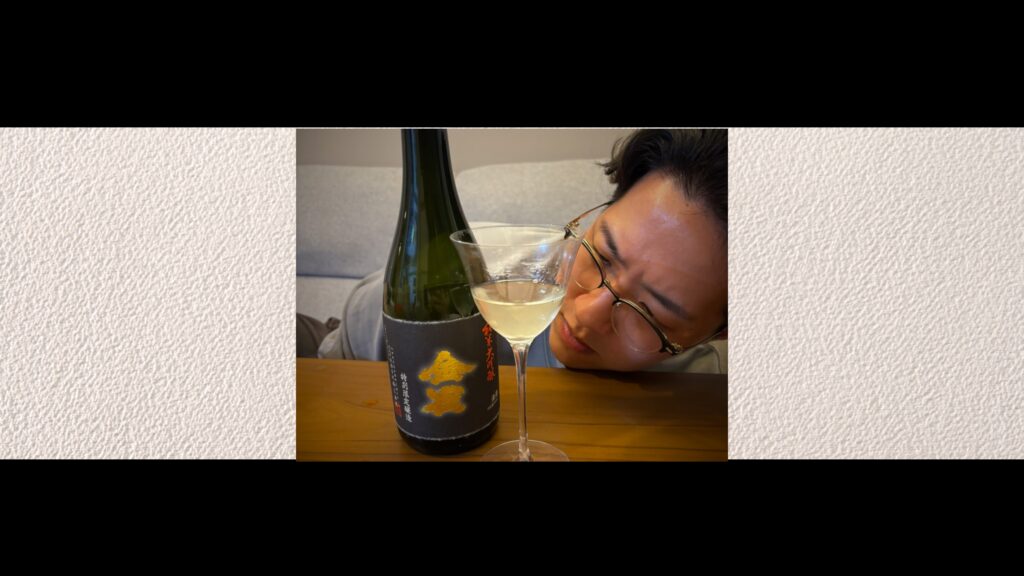
(The sake from that night. I finished the entire bottle the same day.)
Today’s sake is one so good it’s become a reason to travel all the way to Yamaguchi Prefecture. This is Kinsuzume.
On the Position of a Scarce Sake
Horie Sakaba — the brewery behind Kinsuzume, whose official name is 堀江酒場 (Horie Sakaba) — is located in Iwakuni City, Yamaguchi Prefecture.
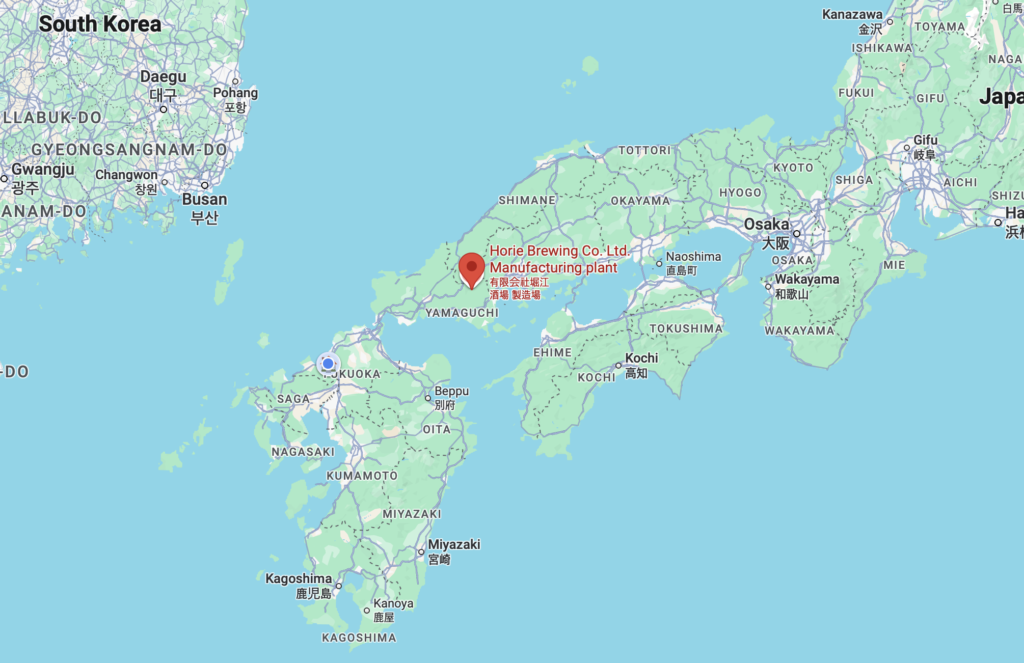
Founded in 1764, Horie Sakaba has been carrying on its tradition for over 250 years, now in its 12th generation of family ownership.
It is the oldest brewery in Yamaguchi Prefecture — and the other notable breweries in the prefecture (Tōyō Bijin, Tenbi, Wakamusume, and others) were all founded after 1800.
The brewery also sits alongside the Nishiki River, Yamaguchi’s longest clear-running waterway, drawing its brewing water directly from it — water so highly regarded it has been named to Japan’s list of 100 Outstanding Waters.
Kinsuzume is one of those scarce sakes where demand among nihonshu fans far outstrips supply.
Like other hard-to-find bottles, the combination of exceptional quality and small-batch production makes it genuinely difficult to get your hands on.
In my case, my wife tracked one down on Mercari (Japan’s secondhand marketplace) and paid above market price as a birthday gift.
And honestly — it was good enough to be worth every extra yen. (I love you..!) Drinking sake sourced from a resale app, I found myself turning over a few thoughts. Let me try to put them into words.
Juyondai, Jikon, Aramasa, Hana-abi, Kinsuzume, Shinshu Kirei. These are the sakes that nihonshu fans traveling to Japan from abroad make a point of seeking out at izakayas.
What they all have in common is this: they’re out of reach for most ordinary consumers.
And the breweries behind them say that dramatically increasing production — while still achieving the flavor they’re after — simply isn’t possible.
There’s likely a deep-seated conviction at these breweries that the toji, the kuramoto, or whoever sits at the heart of the brewing process needs time to be involved in every detail of the sake’s character.
That what is built by human senses cannot be systematized by computers or AI — and is therefore irreplaceable. I share that view entirely.
This line of thinking comes through, at least in part, in what Takagi-san of Takagi Brewery — the maker of Juyondai — has said in interviews.
“Making koji for daiginjo takes 50 hours. Every few hours, the koji trays have to be rotated by hand. How much I suffer through that process doesn’t matter. If the sake turns out delicious, that becomes a deep joy.”
“There are things that can only be felt and learned by a person, on the floor of a brewery.”
I recently wrote about the breweries behind Jikon, Aramasa, and Juyondai — and all three share something in common: for well over a decade, they’ve been iconic examples of sake where supply falls drastically short of demand. And they’ve all taken a firm stance against scaling up production to meet that demand.
Maintaining scarcity could certainly be seen as a form of marketing. (Personally, I think — well, so what if it is.)
But I believe the real reason these breweries earned nationwide followings in the first place is this: their methods of production were never designed for mass output to begin with. Let me give you an example.
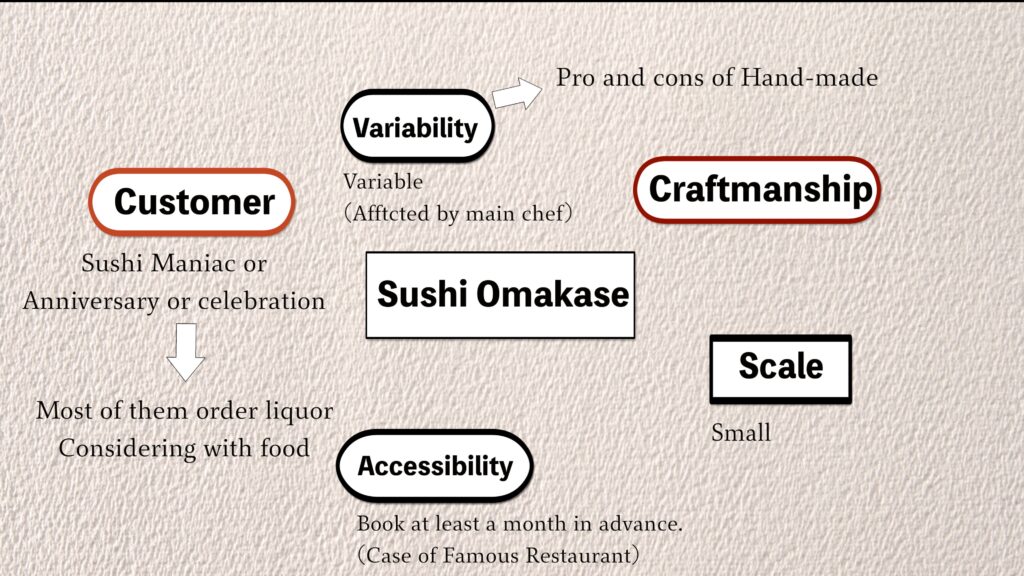
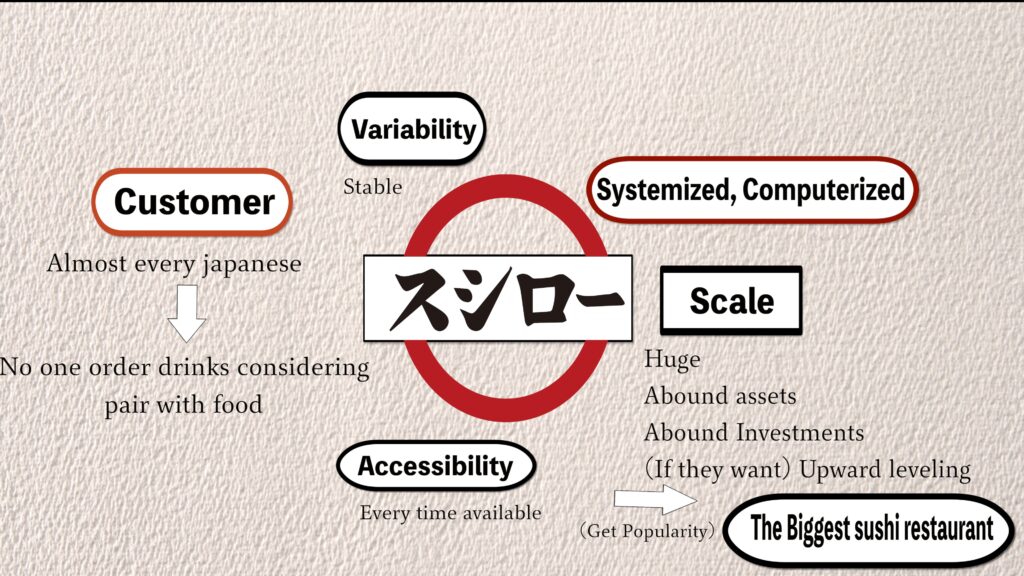
Here are two places: an omakase sushi restaurant, and Sushiro.
The omakase takes only two seatings of eight per day. Sushiro runs from opening at 11am to closing at 11pm, turning over hundreds of tables.
Both have more demand than they can handle — but the difference is clear.
Sushiro exists to offer the best possible taste to as many people as possible, consistently and at scale. The omakase exists to offer the very best the chef is capable of to a select few. At the omakase, it’s the guest who has to call again and again, months in advance, just to find an opening.
Now imagine: to answer that overflowing demand, the omakase decides to add tables, take on apprentices, and turn up the volume.
What happens?
The flavor might not change dramatically.
But even if the head chef’s influence over the food and service remains intact, the restaurant has grown — which means the prep, the aging, the cooking now pass through other hands.
The food and the service will no longer be quite what they were. It would be wonderful if that kind of change led somewhere better.
But when a restaurant that made its name on one chef’s skill and hospitality ends up being run more and more by other hands — expecting that to be a positive shift is not something that falls within ordinary expectations.
And probably — and this is just probably — the head chef would think the same thing. “There are things that can only be felt and learned by a person, in the room where the work is done.”
On the Position of a Mass-Production Brewery
Thank you to everyone around the world who loves Nihonshu and has visited Sakagura Miyamoto. Sakagura Miyamoto was created to make Nihonshu more than just a drink with good taste and aroma — but something that lives in your memories. For those who want to turn Nihonshu from a simple alcoholic beverage into a medium that brings back moments and stories, and for those who want to describe Nihonshu in a deeper, more dimensional way, we invite you to join the Sakagura Miyamoto membership. The content below is for members only. Thank you.
Sources:
https://taste-translation.com/sakes-past-present-and-future-according-to-aramasa-part-1-of-4/ (Aramasa Brewery interview)
https://nihonmono.jp/article/18507/ (Takagi Brewery interview)
https://dassai.com/about/flow.html (About Dassai’s brewing process)